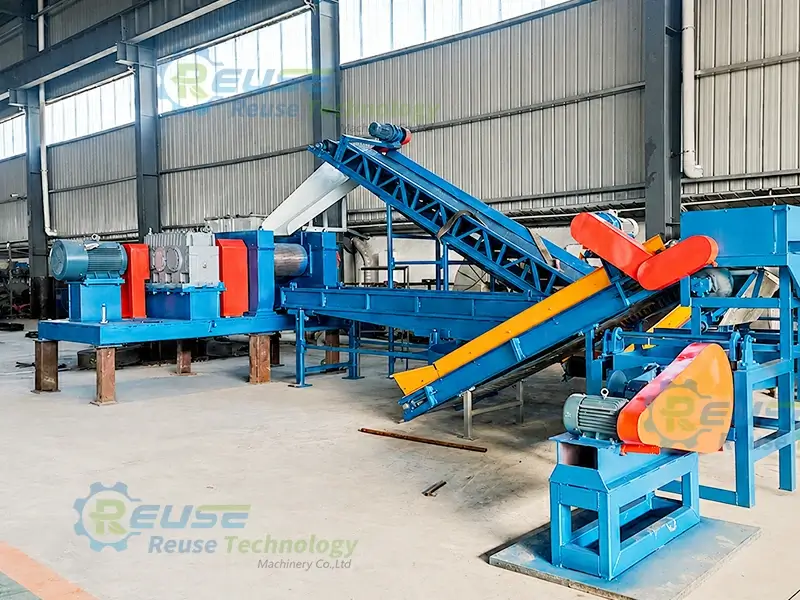
REUSE designs complete tire recycling plant solutions according to your feed tires, required output and production capacity. From primary shredding and steel recovery to rubber granulation, fiber separation and fine powder grinding, each production line can be configured around the final product you plan to produce.
Flexible processing capacities for different projects
Tire shreds, rubber chips, crumb and fine powder
Size reduction and physical material separation
Configured around tire type, capacity and workshop space
Waste Tire Recycling System
What Is a Tire Recycling Plant?
A tire recycling plant is a complete processing system used to convert end-of-life tires into reusable rubber materials, recovered steel and separated textile fiber. Unlike a single tire recycling machine, a complete production line combines several processing stages according to the required finished product.

Complete Waste Tire Processing
A complete rubber recycling plant may include tire cutting, primary shredding, steel wire separation, rubber granulation, screening, fiber separation and fine grinding.
REUSE can configure both tire recycling plant and tyre recycling plant projects for passenger tires, truck tires and selected larger tires.

Different Outputs Need Different Processes
The required equipment depends on what you want to sell. Coarse tire shreds require fewer processing stages, while clean crumb rubber and powder require deeper size reduction and material separation.
- 50–150 mm tire shreds
- 10–30 mm wire-free rubber chips
- 1–7 mm crumb rubber
- 30–100 mesh rubber powder
How It Works
Typical Tire Recycling Plant Process
The processing route varies between different tire recycling plants. Tire size, target capacity, required particle size and product purity determine which machines are needed.
1. Tire Preparation & Primary Shredding
Truck, agricultural and oversized tires may require bead wire removal or cutting before shredding. A tire shredder machine then reduces the tires into controlled-size shreds.
2. Steel Wire Separation
Secondary size reduction releases the steel embedded inside the tire structure. Magnetic separation equipment then removes steel wire from the rubber material.

3. Rubber Granulation
Wire-free rubber chips are further reduced into smaller particles. Screening and fiber separation help control final particle size and rubber cleanliness.
4. Fine Rubber Grinding
When finer recycled rubber is required, clean rubber granules are processed through a tire grinding machine to produce rubber powder.
Production Line Options
Choose a Tire Recycling Plant by Final Product
The right rubber recycling plant should be selected according to the final material you intend to produce. Processing depth increases as the required rubber particle size becomes smaller.
Tire Shredding & TDF Plant
A primary tyre shredding plant reduces whole or pre-cut waste tires into coarse tire shreds for TDF, civil engineering applications or further recycling.
- Typical output: 50–150 mm
- Capacity: 0.5–20 T/H
- Tire-derived fuel
- Secondary recycling feedstock
Wire-Free Rubber Chip Plant
This production line combines tire shredding with further size reduction and steel recovery to produce cleaner rubber chips with most of the embedded steel removed.
- Typical output: 10–30 mm
- Rubber mulch
- Granulator feedstock
- Recovered steel
Crumb Rubber Recycling Plant
This tire recycling plant adds rubber granulation, screening, magnetic separation and fiber removal to produce smaller and cleaner rubber particles.
- Typical output: 1–7 mm
- Sports surfaces
- Rubber mats
- Molded rubber products
- Rubberized asphalt
Rubber Powder Recycling Plant
Clean rubber granules are further ground into fine powder for applications that require smaller particle sizes and higher processing depth.
- Typical output: 30–100 mesh
- Modified asphalt
- Rubber compounds
- Rubber mats and sheets
- Recycled rubber manufacturing
Line Comparison
Compare Tire Recycling Plants
Different final products require different processing depths. The table below provides a quick comparison of the main production line configurations.
| Production Line | Final Product | Typical Size | Main Application |
|---|---|---|---|
| Tire Shredding / TDF Plant | Coarse tire shreds | 50–150 mm | TDF and secondary processing |
| Wire-Free Rubber Chip Plant | Clean rubber chips | 10–30 mm | Mulch and granulator feed |
| Crumb Rubber Plant | Rubber granules | 1–7 mm | Sports and rubber products |
| Rubber Powder Plant | Fine rubber powder | 30–100 mesh | Asphalt and rubber manufacturing |
Individual Equipment
Waste Tire Recycling Plant Machinery
REUSE supplies complete systems as well as individual waste tire recycling plant machinery for new installations, equipment replacement, production upgrades and capacity expansion.

Tire Cutting Machine
Pre-cuts truck, agricultural and oversized tires into manageable sections before further size reduction.

Tire Shredder Machine
Reduces whole or prepared waste tires into controlled-size tire shreds for TDF or downstream processing.

Tire Rasper
Further reduces tire shreds and releases embedded steel wire before magnetic separation.

Steel Wire Separator
Separates steel from rubber material during secondary tire recycling and material recovery.

Rubber Granulator
Processes cleaned rubber chips into smaller uniform granules for further separation and screening.

Fiber Separator
Removes loose textile fiber from recycled rubber granules and helps improve finished material cleanliness.

Tire Grinding Machine
Fine-grinds cleaned rubber granules into rubber powder for higher-value recycled rubber applications.

Vibrating Screen
Classifies rubber particles by size and returns oversized material for additional processing when required.
Project Planning
How to Choose the Right Tire Recycling Plant
A reliable tire recycling plant configuration should be based on your actual feed material, target product and operating conditions rather than production capacity alone.
Confirm the Feed Tire
Provide the tire type and maximum dimensions. Passenger tires, truck tires, agricultural tires and OTR tires can require different preparation and feeding methods.
Define the Final Product
Confirm whether you want TDF shreds, wire-free rubber chips, crumb rubber or fine powder before selecting the processing equipment.
Set the Required Capacity
Hourly throughput, operating hours and production shifts determine the required machine size and overall plant capacity.
Confirm Workshop Conditions
Workshop dimensions, available height, electrical supply, transformer capacity and storage areas should be considered before the final equipment layout.
Modular Plant Design
Build Your Tyre Recycling Plant in Stages
A tyre recycling plant can be expanded as your product market develops. This allows some projects to begin with primary tire shredding before investing in deeper rubber processing.
Start with Tire Shredding
A project can initially produce coarse tire shreds or TDF using tire preparation, shredding and screening equipment.
Add Granulation or Grinding Later
Raspers, steel separators, rubber granulators, fiber separators and grinding equipment can be added later when finer products are required.
End Markets
Applications of Recycled Tire Products
The target market should be confirmed before the tire recycling plant is finalized because particle size and cleanliness directly affect the required processing route.
Tire-Derived Fuel
Controlled tire shreds can be used as alternative fuel in suitable cement kiln and industrial applications.
Rubber Mulch
Wire-free rubber chips can be used for landscaping, ground cover and as feedstock for further granulation.
Crumb Rubber
Rubber granules can be used in sports surfaces, playground applications, molded products and rubberized asphalt.
Rubber Powder
Fine rubber powder can be used in modified asphalt, rubber compounds, fillers and recycled rubber manufacturing.
Need a Tire Recycling Plant Configuration?
Send us your tire type, tire size, required final product, expected capacity and workshop dimensions. REUSE engineers can recommend a suitable recycling process and equipment configuration for your project.
Frequently Asked Questions
Tire Recycling Plant FAQ
What is a tire recycling plant?
A tire recycling plant is a complete production system that combines several machines to process waste tires into tire shreds, rubber chips, crumb rubber, rubber powder and recovered materials.
What is a rubber recycling plant?
A rubber recycling plant processes waste rubber into reusable materials. In tire recycling projects, the term commonly refers to systems that produce rubber chips, granules or powder from waste tires.
Is a tyre recycling plant the same as a tire recycling plant?
Yes. “Tyre recycling plant” is the British English spelling, while “tire recycling plant” is the American English spelling. Both terms refer to the same type of recycling production system.
What machinery is used in a tire recycling plant?
Common equipment includes tire cutting machines, tire shredders, raspers, magnetic separators, rubber granulators, vibrating screens, fiber separators and rubber grinding machines.
Can a tyre shredding plant process truck tires?
Yes. Truck tires can be processed, although bead wire removal or pre-cutting may be required depending on the tire dimensions and selected shredder.
What final products can tire recycling plants produce?
Typical products include TDF tire shreds, wire-free rubber chips, crumb rubber, fine rubber powder and recovered steel.
How is steel removed from waste tires?
Heavy bead wire may be removed before shredding, while steel released during further size reduction is normally recovered using magnetic separation equipment.
Can a tire recycling plant be expanded later?
Yes. A plant can begin with primary shredding and later add steel separation, rubber granulation, fiber separation or fine grinding equipment.
What affects tire recycling plant cost?
The main factors include feed tire size, required capacity, final particle size, product purity, automation level and the number of processing and separation stages.
Can REUSE supply individual waste tire recycling plant machinery?
Yes. REUSE supplies both complete tire recycling lines and individual machines for new projects, existing plant upgrades, capacity expansion and equipment replacement.